Landed Property Categorisation: CAT 1–4
A condition framework for comparing the house you can buy today with the finished home you intend to own.
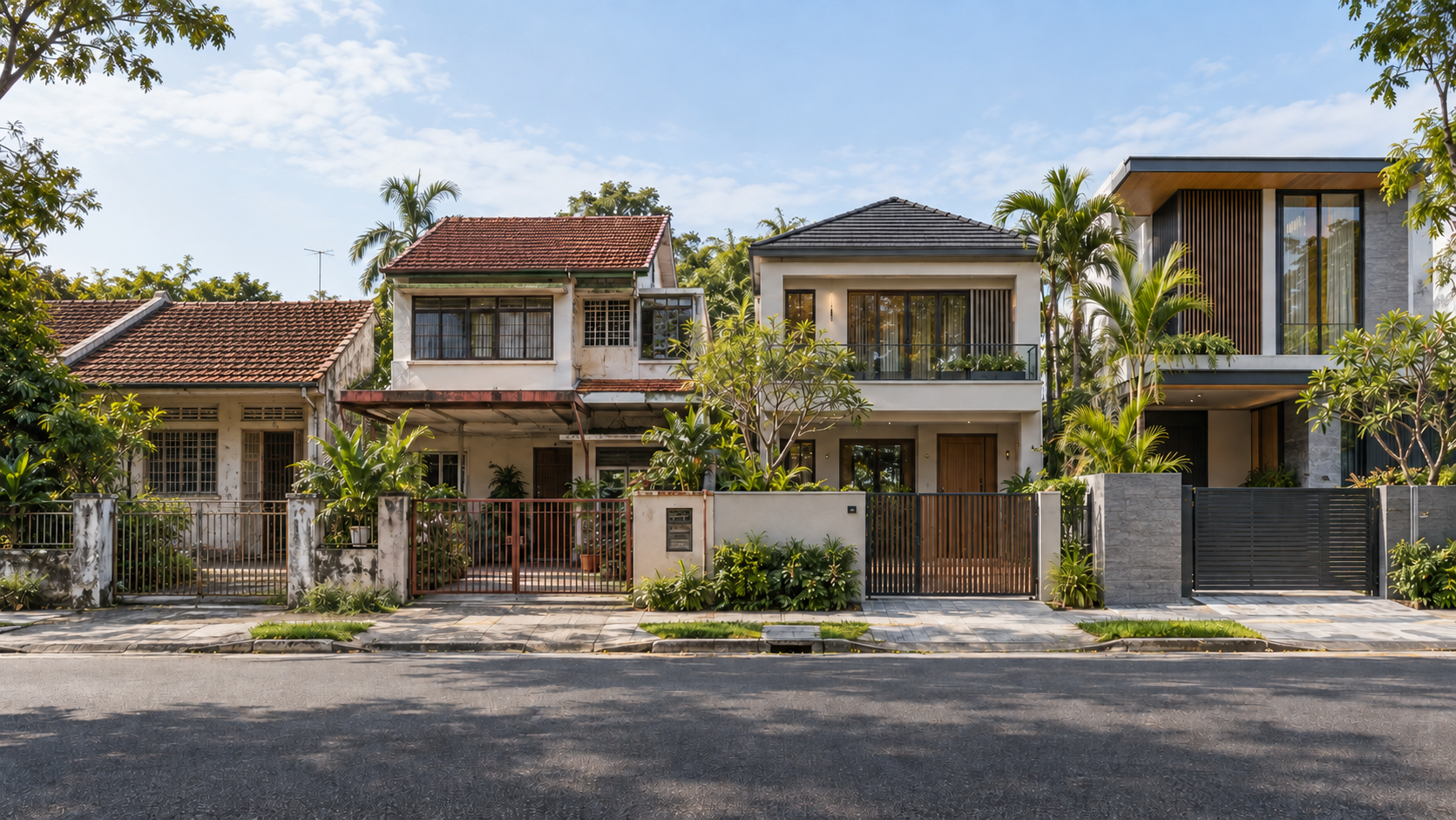
CAT 1–4 at a glance
A quick comparison using broadly similar freehold or 999-year inter-terrace homes with about 1,600–1,900 sq ft of land.
| Category | CAT 1 | CAT 2 | CAT 3 | CAT 4 |
|---|---|---|---|---|
| Typical condition | Original condition, usually 30+ years old | Middle-aged, usually 20+ years old | Newer or well-kept home | Brand-new or developer-rebuilt |
| Likely scope | Total rebuild | Major A&A | Renovation and selective upgrading | Move-in or minor personalisation |
| Works reference | $1.2m–$1.6m | $800k–$1.2m | $300k–$500k | Premium reflected in purchase price |
| Typical programme | 18–24 months | 6–12 months | 3–6 months | Move-in or near-ready |
| D19 asking reference | $4.0m–$4.6m | $4.5m–$5.2m | $4.9m–$5.8m | $6.0m–$7.0m |
These are indicative current asking prices, not completed-sale averages or a valuation. Exact prices depend on street, tenure, plot, frontage, condition and build quality.
Start with the correct order
The categories run from the most work to the least: CAT 1 is an original-condition house on a total-rebuild route; CAT 2 is an older house suited to substantial additions and alterations; CAT 3 is a newer house that generally needs renovation or selective upgrading; CAT 4 is a brand-new or recently developer-rebuilt home. The number describes the likely project ahead, not the quality of the street, tenure or land.
CAT 1 — total rebuild
A CAT 1 home is typically an original structure around 30 years old or more whose layout, structure and services offer little practical value to the next owner. The buyer is principally assessing the land and redevelopment potential, then allowing for demolition, design, approvals, construction, financing, temporary accommodation and contingency. A commonly used terrace-house reference is roughly $1.2 million to $1.6 million and 18 to 24 months, but plot conditions, specification, access and market pricing can move both figures materially.
CAT 2 — substantial A&A
CAT 2 usually describes a middle-aged house, often 20 years old or more, where enough of the building may be retained but the owner wants a major reconfiguration, extension or structural upgrade. A reference allowance often used for this category is about $800,000 and 6 to 12 months. A&A is not simply a large renovation: under prevailing planning guidance, additions to gross floor area, replacement of external walls and structural changes are each generally kept within defined limits; exceeding them, adding a storey or changing the landed housing form can make the proposal a reconstruction instead.
CAT 3 — renovation and selective upgrading
CAT 3 generally covers a newer home, often around 10 to 15 years old, whose basic structure and planning still work. The project may focus on kitchens, bathrooms, finishes, built-ins, lighting, air-conditioning, waterproofing and selected layout improvements rather than rebuilding the house. A broad reference range is $300,000 to $500,000 over about 3 to 6 months. Buyers should still check the roof, wet areas, electrical load, plumbing, termites, concealed defects and whether earlier alterations were approved.
CAT 4 — brand-new or developer-rebuilt
CAT 4 is the ready-made end of the spectrum: a brand-new landed home, commonly rebuilt and sold by a developer. The buyer pays a premium to avoid the design-and-construction journey and can usually occupy much sooner. That premium should be tested against the actual land, frontage, internal planning, build quality, materials, approved plans, completion status and defects—not simply the word “new”. A polished CAT 4 house can still sit on a compromised plot or carry a layout that does not suit the household.
Age is a clue, not the classification
The age bands are useful screening cues, not automatic rules. A well-maintained 25-year-old house may remain highly usable; a much newer house may need major work because of poor planning, water ingress, structural movement or unapproved alterations. Classify the property by the scope required to reach the buyer’s intended outcome after an architect, engineer and other relevant professionals have inspected it.
Compare the completed outcome, not just the asking price
A CAT 1 home may have the lowest purchase price but the highest all-in commitment. Compare acquisition price plus professional fees, authority and submission costs, demolition or renovation, financing during works, rental or temporary housing, contingency and the value of time. Then compare that completed position with a CAT 3 or CAT 4 alternative in a genuinely similar street, tenure, plot shape and land size. This prevents a cheap original-condition house from being compared with an expensive finished home as though the gap were pure profit.
Classify a house before you price it
At the first viewing, ask what must be retained, what must change and when the household needs to move in. Obtain the approved plans and renovation history; inspect for cracks, leaks, roof and drainage issues; test whether the existing floor plan supports the intended rooms and parking; and check the site’s planning envelope, setbacks, road level and access. The useful output is not merely a CAT number—it is a current category, target category, probable work scope, time allowance and all-in budget range.
Disclaimer
CAT 1 to CAT 4 is a buyer-comparison framework, not an official government classification, structural survey, valuation or approval. It does not establish redevelopment feasibility, building safety, legal compliance or market value. Treat it as a way to organise the decision, then confirm the property-specific facts with the appropriate qualified professionals and authorities.