Kallang residential uplift benchmark jumps 23.6% in Distripark sector
The higher land-betterment rate affects value-creating planning proposals, not routine ownership or resale of nearby homes.
Published 2026-10-07 · 5 min read
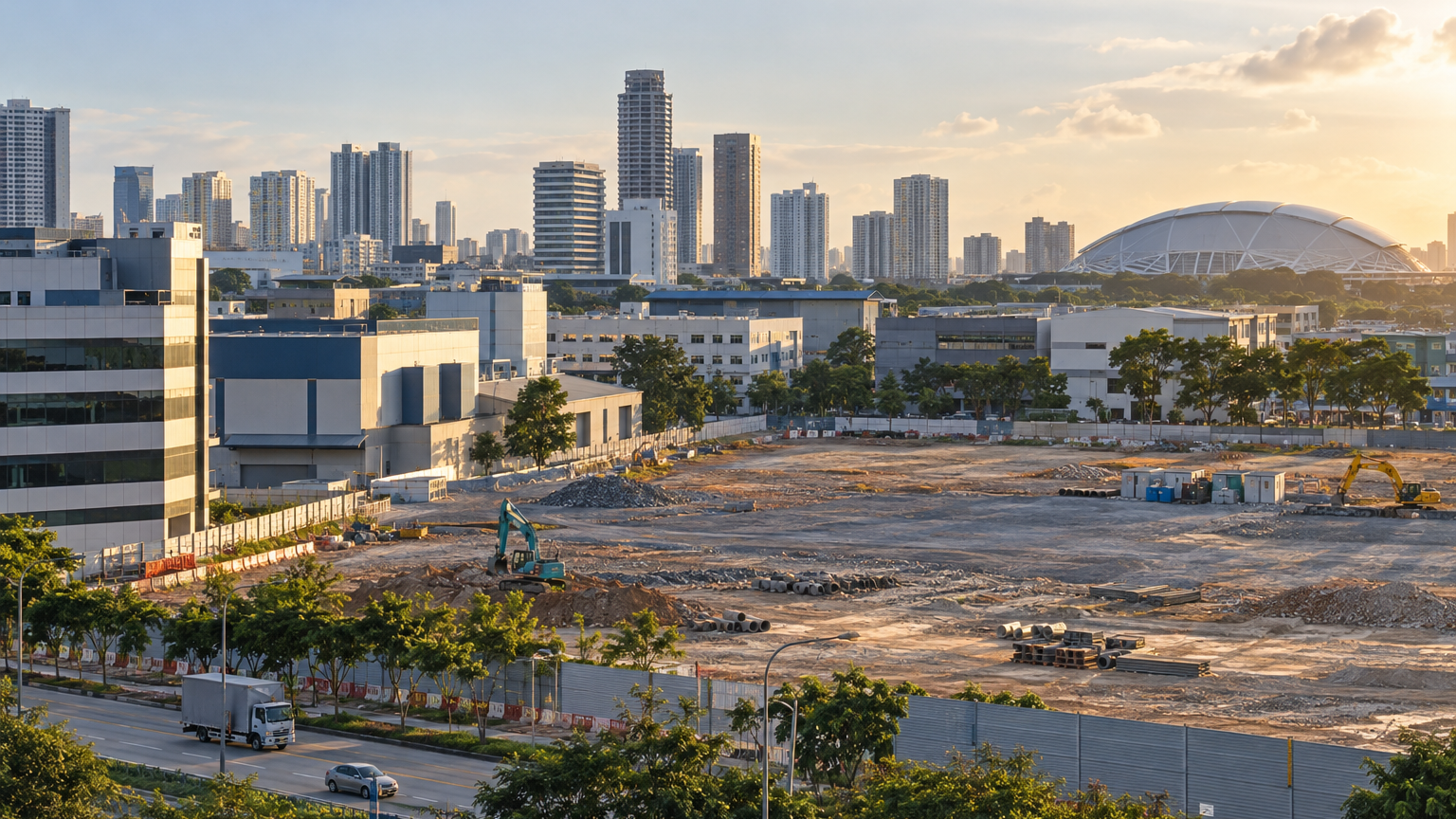
The official benchmark for non-landed residential development in the sector covering Kallang Distripark rose from S$7,700 to S$9,520 per sq m between March and September 2026. That S$1,820 increase works out to 23.6%, compared with a 3.4% average rise across Singapore.
The jump matters because it raises one input used when planning consent unlocks additional land value. It is not a new charge on people simply owning, occupying or selling nearby homes—and it should not be used as a shortcut for valuing landed property in Kallang.
Why the 23.6% increase stands out
Singapore Land Authority’s rates effective from 1 September 2026 put Sector 56’s non-landed residential rate, classified as B2, at S$9,520 per sq m. The corresponding rate under the schedule effective from 1 March was S$7,700 per sq m.
The calculation is straightforward: S$9,520 minus S$7,700 equals S$1,820, and S$1,820 divided by S$7,700 gives 23.6%.
That is almost seven times the nationwide average increase of 3.4% for B2 rates in the September revision. Across Singapore, B2 rates increased in 70 of 118 geographical sectors; landed residential rates, known as B1, rose by an average of 3.5%, with increases in 108 sectors.
The national B2 average has also risen through three consecutive review periods: 0.7% from September 2025, 4.1% from March 2026 and 3.4% from September 2026.
These comparisons show that Sector 56 moved unusually sharply. They do not reveal a final bill for Kallang Distripark, because the published rate is only one part of a site-specific assessment.
What Land Betterment Charge pays for
Land Betterment Charge, or LBC, is a tax on an increase in land value arising from a “chargeable consent”. This can include planning permission, the lodgement of certain plans or a variation of restrictive covenants attached to the title.
In plain English, the charge concerns value created by obtaining new development rights. The assessment compares the land’s position before and after the relevant consent under the prescribed valuation framework.
If SLA determines that taxable betterment has arisen, it issues a Liability Order to the taxable person. Payment is generally due within one month after the order is served.
This is why multiplying Kallang Distripark’s entire land area by S$9,520 would not produce its actual LBC liability. The result can depend on matters including the authorised baseline, proposed use and intensity, land area, applicable use groups and statutory valuation method.
The September rates apply to relevant cases granted Provisional Permission, or a second or subsequent extension of that permission, on or after 1 September 2026.
The landed-home distinction
For someone buying a terrace house, semi-detached house or bungalow, the important point is that a published B1 rate is not automatically a rebuilding charge.
Living in a house, buying it or selling it does not by itself create the planning consent on which LBC is based. The question becomes relevant when a proposal seeks chargeable consent that raises the land’s value above its authorised starting position.
Imagine two similar-sized plots on the same street. One owner plans a replacement house within the established residential use and applicable planning controls. The other needs a restrictive covenant varied or seeks permission that unlocks more valuable development rights. Their LBC positions may differ even if both plots have the same tenure and roughly the same land area.
That is why freehold does not automatically mean exempt, just as leasehold does not automatically mean a charge is payable. Tenure describes the interest held in the land, but the title restrictions, existing authorised position and proposed change remain relevant to the statutory assessment.
Plot size matters when a rate expressed per square metre enters the calculation, but area alone cannot establish liability. A buyer paying a premium for “rebuilding potential” should first establish what the title and planning rules actually allow.
Why this is not a landed-price comparison
The 23.6% figure concerns non-landed residential use in Sector 56. It is not the landed B1 rate and cannot be carried across directly to a terrace, semi-detached house or bungalow elsewhere in Kallang, Whampoa or Geylang Bahru.
SLA assigns different rates by geographical sector and use group. It also made minor boundary adjustments to Sectors 7, 16, 23 and 35 for the September schedule, so the proper starting point is the current sector map for the actual parcel—not a postal district or a broad neighbourhood name.
There is separate planning activity around the wider area. In August 2026, URA gazetted proposed Master Plan amendments covering Geylang Bahru, Kallang Bahru and Kallang River.
The word “proposed” matters. Those amendments provide useful neighbourhood context, but the reviewed official material does not establish an approved Kallang Distripark housing scheme, final housing yield, redevelopment date or site-specific LBC liability.
Likewise, a higher table rate does not disclose what completed homes might sell for. It measures one benchmark within the land-betterment framework, not the full economics of buying land, obtaining permission, constructing a project and selling the finished homes.
What owners and buyers should establish
For a landed property, four separate questions determine whether the headline rate is even relevant:
- What interest is being bought? Check the tenure, remaining lease where applicable, easements and restrictive covenants.
- What is already authorised? Establish the existing lawful use and development baseline.
- What permission would the proposed rebuild require? Replacing a house within existing rights is different from seeking additional valuable rights.
- Which sector and use group apply? Use the parcel’s location and proposed use rather than a district-wide percentage.
SLA provides an online estimator for selected proposals, but describes the resulting estimate as indicative. A purchase or major rebuilding plan may therefore require a title review and advice based on the actual design and planning application.
Sector 56’s 23.6% jump makes the benchmark for creating non-landed residential value materially higher than it was in March. The number that ultimately matters, however, will come from an actual proposal assessed against the site’s authorised baseline—not from the district label alone.