Landed Home Prices Jumped 2.8%—But Your Plot Still Sets the Value
The quarterly rise outpaced condos even as private sales fell, making tenure, site dimensions and rebuilding rules crucial to judging an individual house.
Published 2026-10-06 · 7 min read
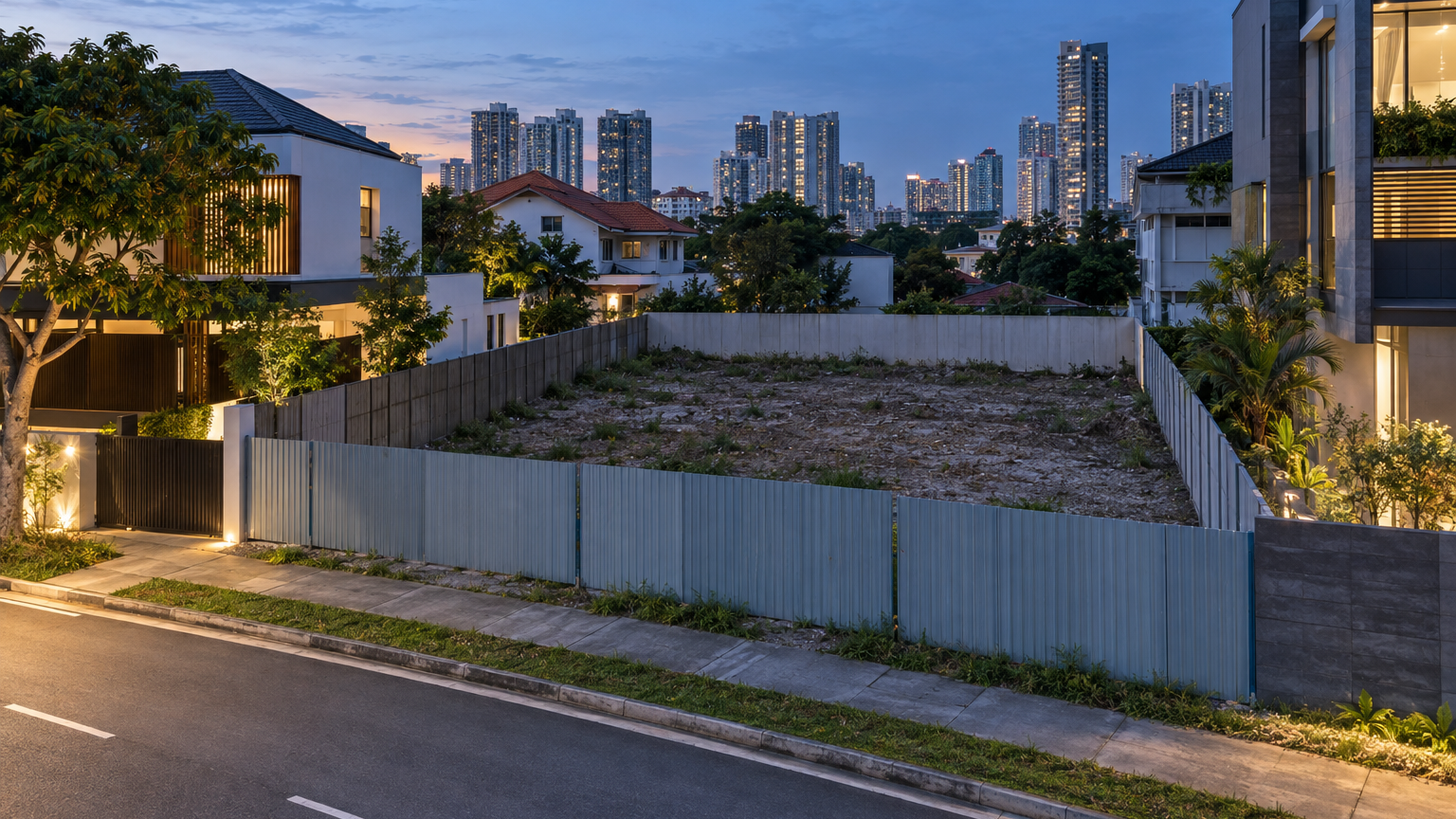
Landed-home prices rose 2.8% in the third quarter of 2026, outpacing the 1.4% increase across Singapore’s private residential market. Yet only 4,296 private-home sales were recorded by mid-September, down from 6,148 in the previous quarter—roughly 30% fewer transactions.
That combination matters if you are pricing an old terrace house, deciding whether to sell, or wondering if a rebuild still makes financial sense. The index shows that transacted landed properties became dearer as a group. It does not add 2.8% mechanically to every house: the value and possibilities of an individual property still depend heavily on its tenure, plot, frontage, condition and planning constraints.
Prices climbed faster in the landed segment
The latest rise was not a one-quarter blip. URA’s landed-property price index had already increased 2.5% in the second quarter, followed by the third quarter’s 2.8% gain. Overall private-home prices rose by a more modest 0.5% and 1.4% in those respective quarters.
Non-landed homes—including private apartments and condominiums—recorded a 0.9% increase in the third quarter. Prices rose 2.2% in the Outside Central Region, which broadly covers Singapore’s suburban private housing market, while the Rest of Central Region gained 0.2%. The Core Central Region edged down 0.1%.
The landed result is useful evidence of recent market direction, particularly for owners comparing current interest with offers received six or 12 months ago. But it is an index built from transactions across Singapore, not a valuation of a particular street or plot.
A freehold semi-detached house on a regular plot, for example, is not directly comparable with a leasehold terrace house that has a shorter remaining term. Nor should a renovated home with a practical layout necessarily move in step with an ageing building that a buyer expects to demolish.
This is especially important when transaction volume falls. A price index can rise because the properties sold during the quarter differ in location, attributes and price from those sold previously. The headline movement remains real, but fewer recorded deals leave owners with less recent evidence for matching a distinctive house to a genuinely comparable sale.
The plot may matter more than the old building
For some older landed homes, buyers focus mainly on the site. They may expect to spend substantially on additions and alterations or to replace the building altogether. In that situation, an attractive façade or a large existing floor area matters less if the eventual design cannot fit within today’s planning rules.
URA’s prevailing controls distinguish among detached, semi-detached and terrace housing. They set parameters such as minimum plot size, plot width, building setbacks and, where applicable, site coverage. A detached house generally requires at least 400 sq m of land, while a semi-detached house or Corner Terrace-I plot generally requires at least 200 sq m.
These are planning thresholds, not suggested prices or guarantees that a particular redevelopment will be approved. The shape of the site matters too. Two plots with the same land area can offer different design options if one is narrow, irregular, steep or constrained by the position of neighbouring buildings.
The permitted building envelope—the three-dimensional space within which a house must fit—also affects what can be rebuilt. Applicable height controls may allow two or three storeys, but the lower of the relevant landed-housing control and any prescribed Master Plan storey height applies.
Location can add another layer. URA’s locational rules determine where particular landed-house forms may be developed, while designated landed housing areas help preserve the character and low-rise form of established neighbourhoods. Some streets also have street-block plans with more specific requirements; one such plan covers parts of Onan Road, Carpmael Road and Ceylon Lane.
This is why “rebuild potential” should be checked rather than assumed. Before paying a premium for an architect’s concept, a buyer should establish the approved house type, plot dimensions, applicable setbacks, height control and any street-specific or conservation requirements. A sketch showing a generous floor area is only a proposal until those constraints have been tested.
Decide whether you are buying land or a usable home
A practical way to compare landed listings is to separate them into two broad—and sometimes overlapping—categories.
The first is a site-led purchase. The existing building may be dated, poorly arranged or near the end of its useful life for the buyer. Here, the relevant comparison is not simply another house with the same number of bedrooms. It is a plot with similar tenure, land area, width, house type, planning context and access.
The second is a home-led purchase. The current structure already suits the household, perhaps after a recent renovation. Its layout, condition, natural light and ability to accommodate ageing parents or young children may save years of design, approvals and construction. Buyers can reasonably value that usability, even if another nearby plot looks cheaper on a per-square-foot-of-land basis.
The distinction helps explain why applying a uniform 2.8% uplift can mislead. An owner selling a move-in-ready house may be competing for buyers who want convenience. An owner selling an old structure may face buyers who deduct demolition, professional, approval, financing and construction costs from what they can pay for the land.
Tenure deserves equal attention. A freehold title and a leasehold title with a declining balance do not give a buyer the same duration of ownership. The quarterly landed index supplied in the flash estimate does not split its result by freehold versus leasehold tenure, house type, district, land area, condition or redevelopment potential.
For owners, the useful exercise is therefore a neighbourhood comparison rather than a national-index calculation. Start with completed sales of the same house form and similar tenure nearby. Then adjust the comparison for plot width and shape, road conditions, existing building quality and credible rebuilding options—not merely for elapsed time and the latest quarterly percentage.
HDB’s dip is a separate piece of the picture
HDB’s flash estimate put the resale price index 0.2% lower in the third quarter, marking a third consecutive quarterly decline. At the same time, 7,528 resale flats changed hands by 29 September, 17.7% more than in the preceding quarter.
For households hoping eventually to move from a flat to a landed home, these figures describe two parts of their affordability equation: what their present flat may fetch and what the next home may cost. But the releases do not establish that flat owners upgrading caused landed prices to rise.
Broader supply also requires careful reading. URA said 4,745 private homes would be offered through the Confirmed List of the Government Land Sales Programme in the second half of 2026, bringing the full-year total to 9,320. Around 60,600 private homes and executive condominiums are expected to be completed over the next few years.
That pipeline can affect choices across the private market, but it is not a matching supply of landed houses. A family searching for a freehold corner terrace in one school zone cannot substitute most new condominium units for that particular requirement.
There is one final timing point. URA released these private-market numbers as a flash estimate, based on transaction information available up to mid-September. The full third-quarter statistics are due on 23 October 2026, and the preliminary figures may be revised.
Until then, the 2.8% increase is a strong piece of market context—not a ready-made asking-price adjustment. For any one landed home, the more useful question remains wonderfully physical: what exactly is on the plot today, and what can legally and sensibly stand there next?